
“Make it Instagrammable” is the most common line in a pop-up brief and the least useful. It describes the result, not the design. A room does not become shareable because someone put a neon sign on a wall; it becomes shareable because the brand gave visitors something to do, wear, hold or stand inside that is worth showing someone else.
Rather than hand you a generic list, we went back through activations we have actually produced and pulled five that built a photo moment on purpose. Every example below is a real pop-up on one of our spaces, linked to its page. What each one did is taken from the brand’s own pop-up page; what it means for your build is our read, as the team that produces 150+ pop-ups a year.
1. Make the photo moment an activity: Dom Pérignon × Murakami
For three days in October 2025, Dom Pérignon took over 262 Mott Street to celebrate Takashi Murakami’s designs for its Vintage 2015 champagne. The Murakami Flower Studio had two photo-friendly ideas at its centre: guests could craft their own Ikebana floral arrangements, and an AR mirror photo booth was set among the artist’s signature smiling blossoms.
The lesson: the brand did not stage a backdrop and hope. It put the camera inside the experience, and it tied the visual to the product’s story — the flower motif is the collaboration. A photo moment that could belong to any brand is decoration; one that is only possible because of your product is content.
2. Give them a reason to stay and play: FabFitFun
In June 2026, FabFitFun ran a weekend at 262 Mott Street built around its Build-A-Box format: guests assembled their own box by choosing six full-size products. According to the pop-up page, the room also had photo moments, claw-machine prizes and surprise giveaways — “plenty of reasons to stay longer than planned.”
The lesson: photo moments work best as one beat in a sequence, not the destination. A claw machine is a game that happens to photograph well; the box-building is the product experience; the photos are a by-product. Visitors who are busy doing something take better, more natural pictures than visitors who are standing in front of a wall.
3. Pick one idea and commit: Summer Fridays’ Sun Room
When Summer Fridays launched its first fragrance in March 2026, it did it at 22 Wooster Street as The Sun Room: an immersive space “bathed in golden light,” with fragrance sampling, complimentary vanilla lattes and a free travel-size Sunlit Vanilla Eau de Parfum for the first 150 guests each day. The page describes it as one of the most talked-about beauty pop-ups in SoHo that weekend.
The lesson: the whole room was one sensation — warm light, vanilla — named after the product. When the idea is that clear, every corner is a photograph and nobody needs to be told where to stand. The daily giveaway cap also gave people a reason to arrive early rather than eventually.
4. Let colour do the work: BODY by Raven Tracy
We covered this build in detail in our BODY by Raven Tracy case study. The short version for photography: pink carpet ran the full floor of the 1,600 sq ft corner space at 262 Mott, brushed-metal panels bounced the colour back, preserved florals climbed the facade and hung from the ceiling grid, and a magenta vinyl graphic filled the window.
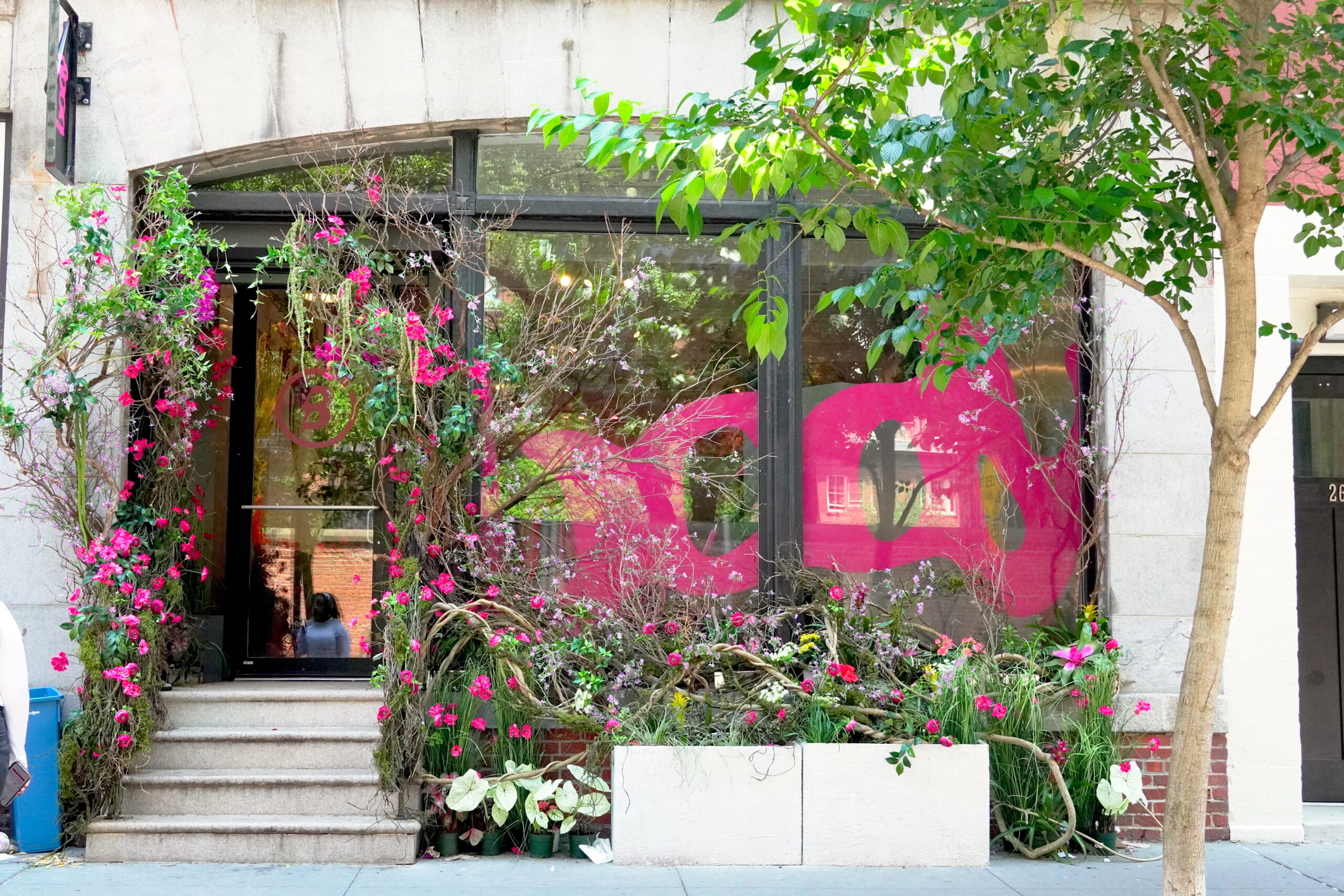
The lesson: a single dominant colour, repeated on the floor, the rails and the glass, is the cheapest way to turn a white box into a place people photograph. It also survives bad phone cameras and tight crops, because the colour is in every frame.
5. Build the moment around people, not product: SIGMA headshots
At 21 Spring Street (850 sq ft), camera maker SIGMA launched its BF camera in a pop-up that included free headshots. We ran the headshot day with photographer Eloise Scoley, and in our case study we recorded that the line outside never stopped, the session produced 50+ portraits, and 50+ new Parasol Members signed up on the spot.
The lesson: the most shareable thing in a room is often the visitor. A free, useful photo of themselves gives people something to post that is about them — with your brand in the frame — and a reason to queue outside, which is its own kind of advertising.
What the five have in common
Look across them and the pattern is not a backdrop style. It is three decisions made before design started:
- What will the visitor do? Craft, play, sniff, queue for a portrait. The photograph follows the action.
- What is the one sensory idea? A flower, a colour, a quality of light. If you cannot say it in three words, the room will not photograph as one thing.
- What is visible from the street? The window is the first photo moment, and the one most brands under-design. 2 Rivington, for example, has a ten-foot all-glass frontage that turns the whole front into a display.
Practical constraints to design around
A few house rules shape any photo-led build in our spaces, so it is better to plan for them than to discover them mid-install:
- Walls and ceilings. Paint, vinyl and wallpaper are approved in advance, and nothing hangs from the ceiling without our sign-off. Painting and electrical work are done by Parasol.
- Sound. The spaces have no built-in sound system, and amplified sound needs prior written approval.
- Timing. Standard setups using rental fixtures need 3 to 4 weeks before your start date; custom fabrication and complex installations need 8 to 12 weeks. An AR mirror or a custom installation sits in the second group — see the real production timeline.
- Crowds and permits. If a photo moment is going to draw a queue inside, check the 75-person assembly threshold in our permits guide.
Where we come in
Designing for the camera is part of our production service: we design, build and install the room, and can work out the one idea and the one photo moment with you before anything is ordered. Production consultations are free — browse the spaces or start an inquiry below.
Frequently asked questions
What makes a pop-up Instagrammable?
In the activations we have produced, it comes down to a clear sensory idea (one colour, one quality of light, one motif), something for visitors to do rather than just stand in front of, and a strong street-facing window. A backdrop on its own is rarely enough.
Do I need a custom installation to get good photos?
No. A single dominant colour carried across floor, fixtures and window vinyl, as in the BODY by Raven Tracy build, does a great deal with standard fixtures. Custom fabrication and complex installations are possible but need 8 to 12 weeks, versus 3 to 4 weeks for standard setups.
Can I paint the walls or hang installations from the ceiling at your spaces?
Paint, vinyl and wallpaper are approved in advance, and painting and electrical work are done by Parasol. Nothing is hung from the ceiling without our sign-off, so share any hanging elements early in the design.
Which Parasol space is best for a photo-led pop-up?
It depends on the idea. 262 Mott Street (1,600 sq ft, corner frontage) hosted the Dom Pérignon, FabFitFun and BODY activations; 22 Wooster Street suits large immersive builds; 21 Spring Street (850 sq ft) and 2 Rivington Street (550 sq ft, all-glass frontage) suit smaller, window-led concepts.
How do I plan a photo moment for a big crowd?
Think about queue flow and headcount early. If you expect 75 or more people inside at once, a Temporary Place of Assembly certificate may apply. Our team can walk through this with you in a free production consultation.